Examples
The outcomes of adult participation in public library making activities are highly individualized and contextual. These narrative portraits share the stories and outcomes of makers who participated in our research. To protect their confidentiality, all names are pseudonyms. Each maker’s personalized outcomes are shown in purple on their individual outcomes wheel. Potential outcomes that were not reflected in the maker’s portrait are marked in gray.
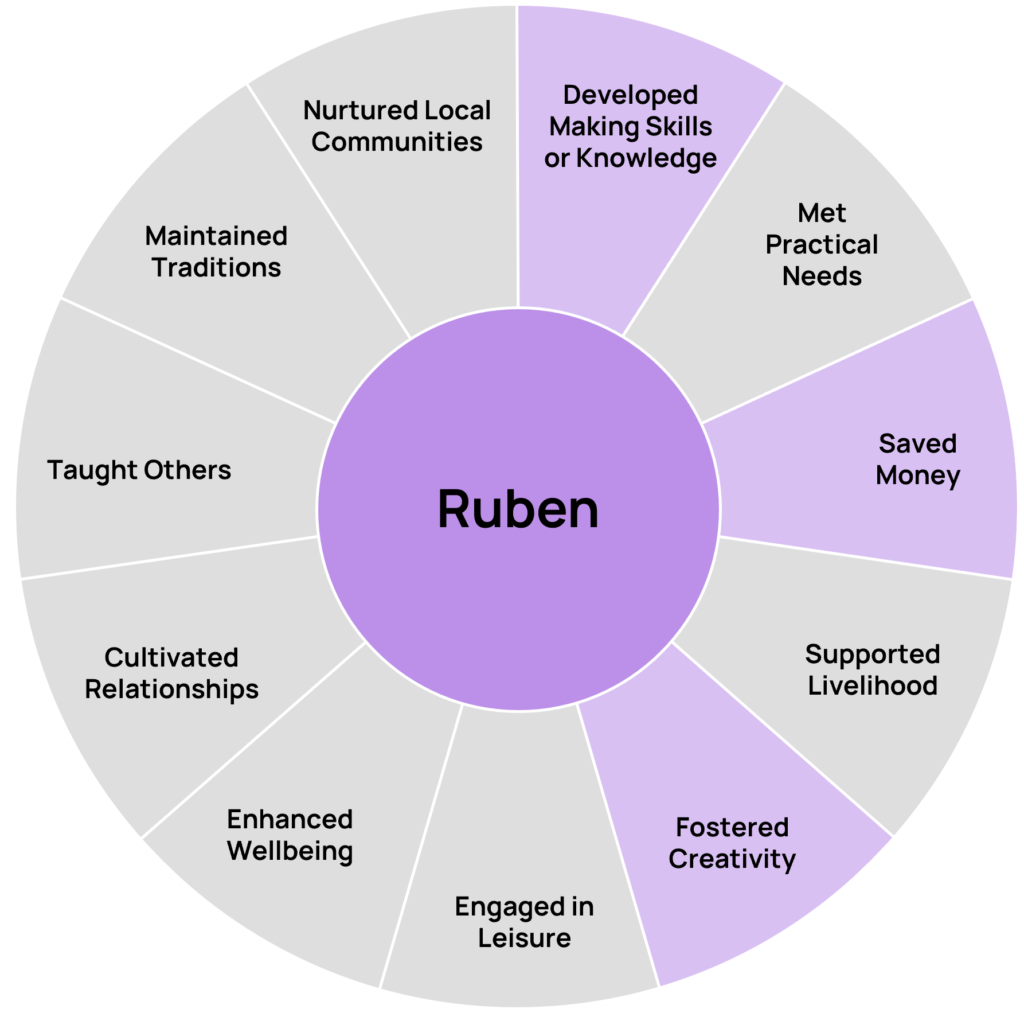
Ruben is a Latino musician in his 30s who uses the makerspace at his local public library to make music and build electronic musical equipment. He has realized the following outcomes through his participation: Developed Making Skills or Knowledge, Saved Money, and Nurtured Creativity.
Ruben’s engagement started with using the makerspace recording studio to create his own music. This activity evolved into an interest in building his own musical equipment. Ruben had experience using digital audio workstations, such as Logic Pro 10, from his educational background in composition and music theory. His interest was piqued by the mechanics of musical equipment, which led him to expand his makerspace participation to learn more about circuitry, programming, and coding (Developed Making Skills or Knowledge).
The makerspace had an inventory of electronic parts and hardware, such as microcontrollers, circuit boards, and a soldering iron, which makers could use without a library card or prior knowledge. Leveraging the makerspace tools, resources, and staff assistance, Ruben built his first MIDI launcher using an Adafruit kit. The staff, who had basic knowledge about electronics and circuitry, were able to help Ruben with the physical circuitry of the MIDI launcher to a certain extent and assisted him in seeking resources on the Adafruit website, such as tutorials and user guides for soldering and orienting the circuit boards. They were also able to help him find resources to learn about coding and programming. Ultimately, Ruben used the resources and equipment in the makerspace to teach himself about multiple aspects of circuitry and coding (Developed Making Skills or Knowledge).
As a result of creating his own MIDI launcher, Ruben developed a new appreciation for the physical aspect of making music, literally building the electrical components that contribute to his music-making. Manufacturing his own equipment gave him a renewed sense of control and ownership over his artistry, providing him with opportunities to explore different levels and new ways of sound customization and interaction (Nurtured Creativity). Additionally, it saved him hundreds of dollars because he was able to build the MIDI launcher using an inexpensive kit and freely available makerspace equipment and resources (Saved Money).
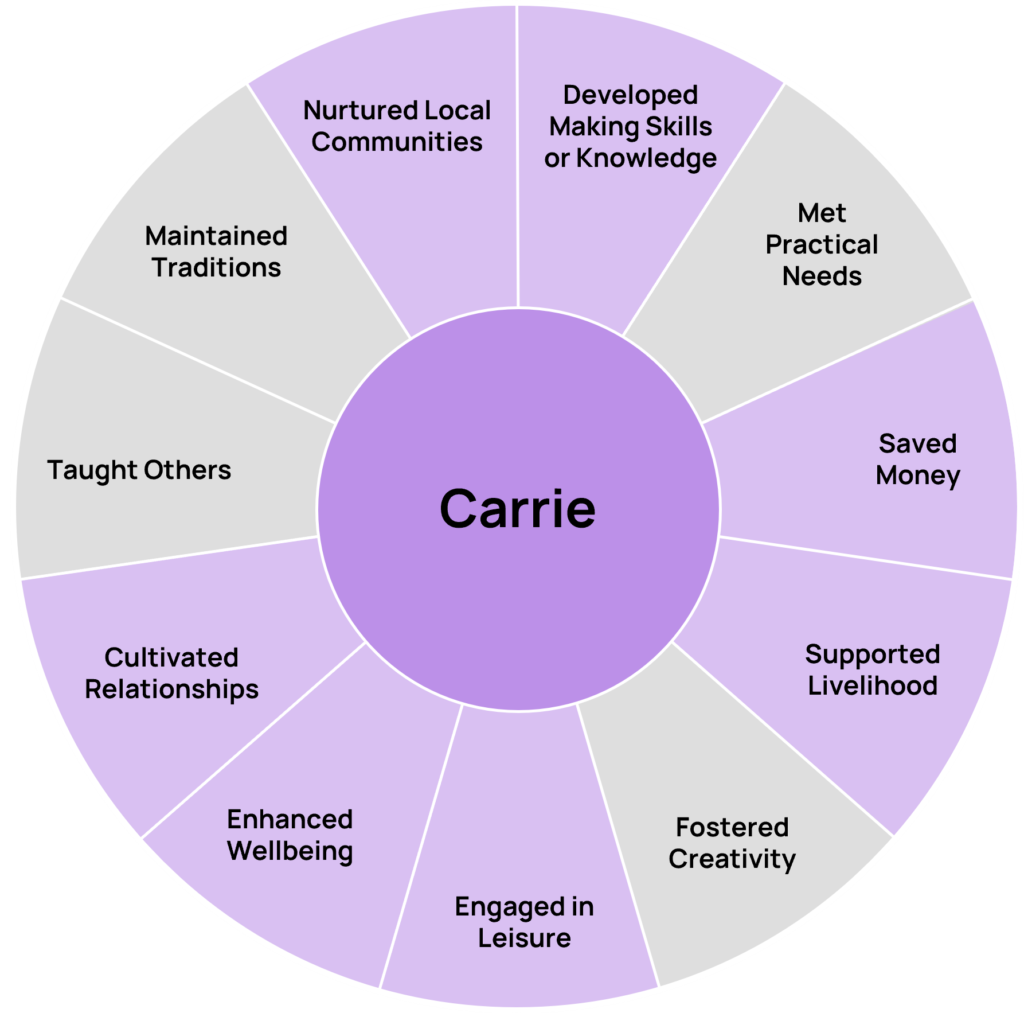
Carrie is a Black woman in her 40s who is an avid crafter and works in the legal system. She visits her public library makerspace multiple times a week and has realized numerous outcomes: Developed Making Skills or Knowledge, Saved Money, Supported Livelihood, Engaged in Leisure, Enhanced Wellbeing, Cultivated Relationships, and Bolstered Local Communities.
Carrie describes makerspace visits as therapeutic because they offer a reprieve from workplace stress (Enhanced Wellbeing). Her passion for the makerspace is well-known among her co-workers, as she occasionally leaves work early to attend classes. Even though the makerspace is her escape from her job, Carrie often creates items there to support her work with families affected by violence, including pins with pictures of loved ones lost to violence for family members to wear to court (Bolstered Local Communities).
In addition to her full-time job, Carrie operates a crafting business, through which she creates custom bouquets, money boxes, graduation mortarboards, and cups, among other items (Supported Livelihood). Carrie also runs a family business with her daughter and her niece. They often take makerspace classes together to learn new skills (Developed Making Skills & Knowledge) and support each other (Cultivated Relationships). She frequently records her activities in class to broadcast on the YouTube channel she operates as another source of extra income (Supported Livelihood). In addition to supporting her business, the classes offer her an alternative to making expensive items for herself, such as wreaths. Carrie takes immense pride in showcasing how she can make custom items for free or at low cost by using makerspace resources (Saved Money).
Even though Carrie owns a lot of crafting equipment at home, she visits the makerspace for a break from her daily responsibilities (Engaged in Leisure) and the opportunity to meet people from different backgrounds, form new friendships, and be in community with other makers (Cultivated Relationships). Through these connections, Carrie exchanges ideas and receives feedback on her projects (Developed Making Knowledge and Skills). Maahika is one maker that Carrie befriended through the makerspace. They now collaborate on craft projects and share new ideas. Being with her “library girls”, such as Maahika, gives Carrie a sense of belonging in the makerspace.
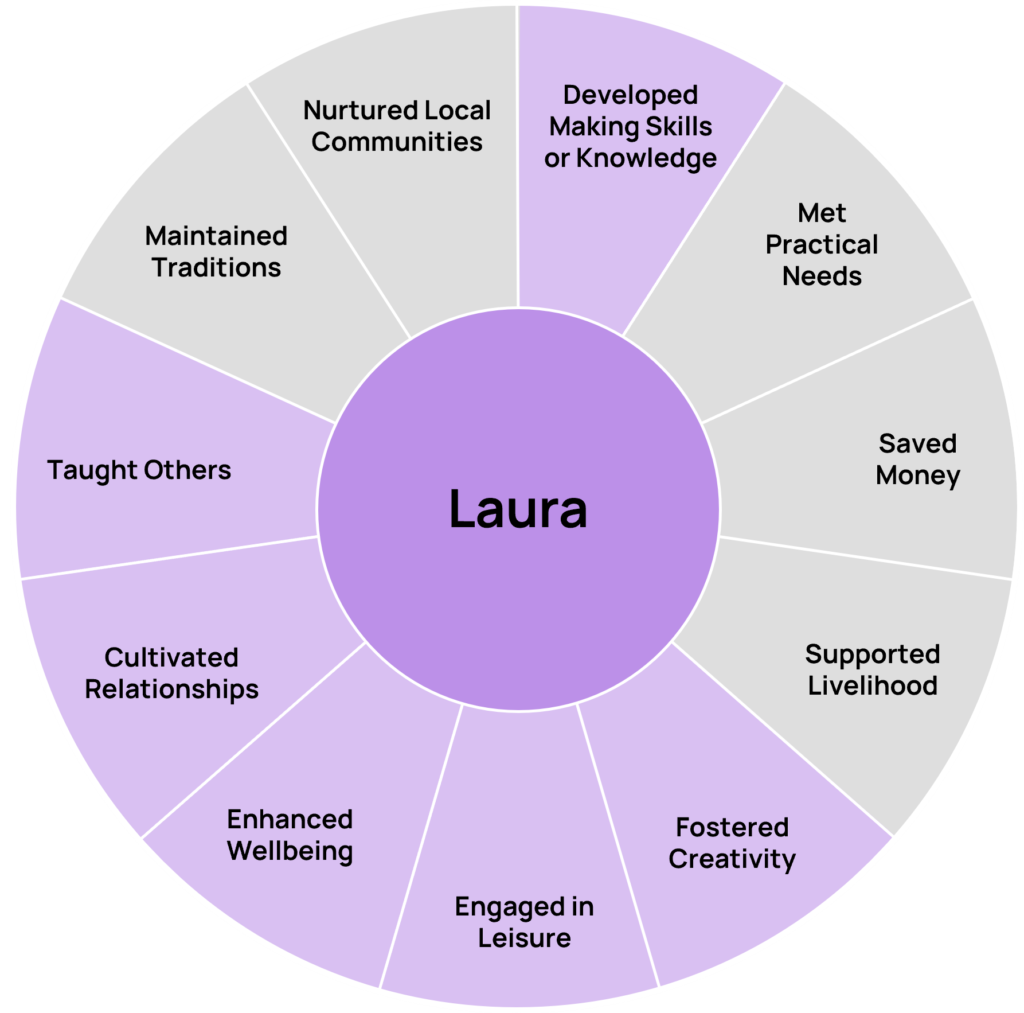
Laura is a Latina homemaker in her 50s who frequents her public library to attend a wide variety of Spanish-language programs. She regularly participates in makerspace arts and crafts programs and has realized the following outcomes: Developed Making Skills or Knowledge, Nurtured Creativity, Engaged in Leisure, Enhanced Wellbeing, Cultivated Relationships, and Taught Others.
Laura’s participation started when her daughter signed her up for a Spanish-language makerspace activity. Her initial inhibition disappeared soon after meeting the other women who attended, as she felt welcome when they talked and shared about their lives. The Spanish-language making programs attract a regular group of Latinas, who participate in a variety of crafting activities, including painting, creating home decorations, and crocheting. Laura also participates in library English classes, Zumba, and meditation with the group.
For Laura, making activities at the library provide a respite from her daily responsibilities (Engaged in Leisure) and have introduced her to a community of Latinas with whom she has formed close friendships (Cultivated Relationships). The interactive programs enable the women to share their talents and cultures with one another. Laura has learned from her peers (Developed Making Skills or Knowledge) and has shared her own expertise with others (Taught Others). Participation is also a form of creative self-expression for Laura, as she enjoys personalizing the items she creates to reflect herself in her art (Nurtured Creativity).
Attending the Spanish-language makerspace activities, along with other library programs, serves as a support system for Laura and her peers. As they work on making activities, the women talk about their lives and offer support and advice about issues such as conflicts at home, depression, and domestic violence. Laura sees the group as a way for women to take care of themselves physically and mentally (Enhanced Wellbeing). Participation also supports Laura and her peers in developing an identity of their own, separate from their familial and domestic responsibilities, and feeling empowered (Enhanced Wellbeing).
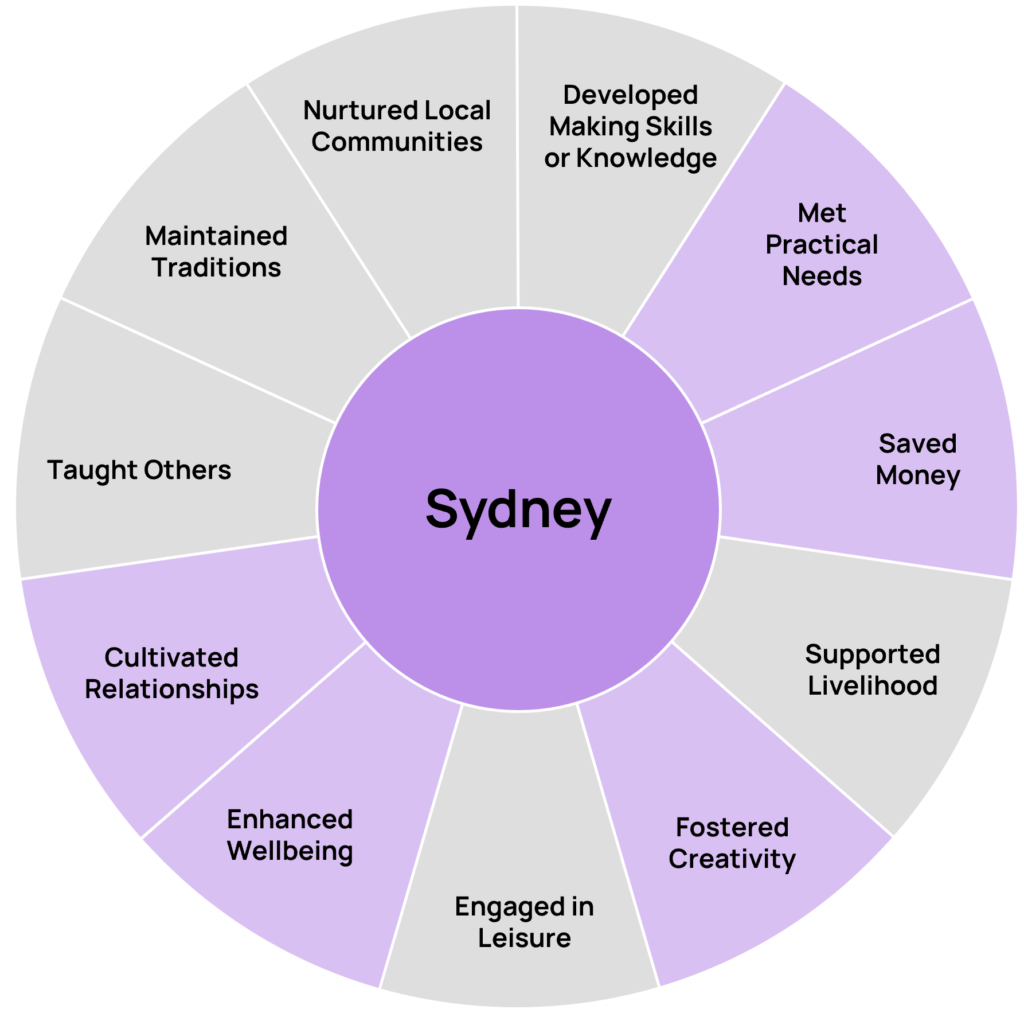
Sydney is an agender person in their 30s who identifies as Black, White, and Multiracial. They are a self-described “crafty, DIY-type” who has realized several outcomes through their visits to their local library makerspace: Met Practical Need, Saved Money, Nurtured Creativity, Enhanced Wellbeing, and Cultivated Relationships.
As a long-time crochet hobbyist, Sydney likes to work on projects at home, on the bus, and elsewhere. Previously, Sydney would go around to other libraries to inquire about yarn groups, but when they moved to their current neighborhood a year ago, they stopped at their local library’s makerspace to fix a pair of broken glasses (Met Practical Need) and learned about a new yarn group. While the fix for their glasses was temporary, the yarn group initiated their regular biweekly visits to this makerspace.
Sydney often gathers crafting inspiration from the physical environment and equipment available in the makerspace. Seeing the industrial sewing machines prompted them to get back into sewing, an activity they had some prior experience with. So far, they have used the sewing machine to create stuffed animals and a dress (Nurtured Creativity). Whenever Sydney runs out of materials or wants to experiment with a new craft or equipment, they like to check the makerspace’s supplies as a cost-effective option for materials. In the past, they used free poly-fill, safety eyes, and safety noses for their sock puppet creations and found yarn to complete their crochet projects (Saved Money). To maintain the makerspace’s material supplies, they also like to donate yarn and crochet needles. Sydney uses attending the yarn group at the makerspace as an opportunity to run other library errands, such as picking up their book holds. The makerspace also gives them a reason to get out of their house (Enhanced Wellbeing) by offering a working environment for yarn crafting that is free of pet hair and distractions
Since they sometimes feel like a “wallflower,” Sydney uses their time in the makerspace to practice small talk and draw inspiration from other makers’ projects. While reflecting on their makerspace activities, they realized that their participation in the yarn group was less about crocheting and more about socializing with other group members (Cultivated Relationships). They often arrive an hour before the yarn group meetings to work on their crochet and sewing projects and appreciate that the makerspace brings together people of all ages, which gives them an opportunity to be around and interact with children.
Sydney considers themself an honorary employee of the makerspace, and as a part of the role, they like to be knowledgeable about it and facilitate learning for new members in the yarn group. Additionally, they help the staff clean up after sessions and occasionally join in conversations about different topics. For Sydney, helping in the makerspace—and never being made to feel like they are overstepping or being “too much”—builds their sense of belonging in the space.
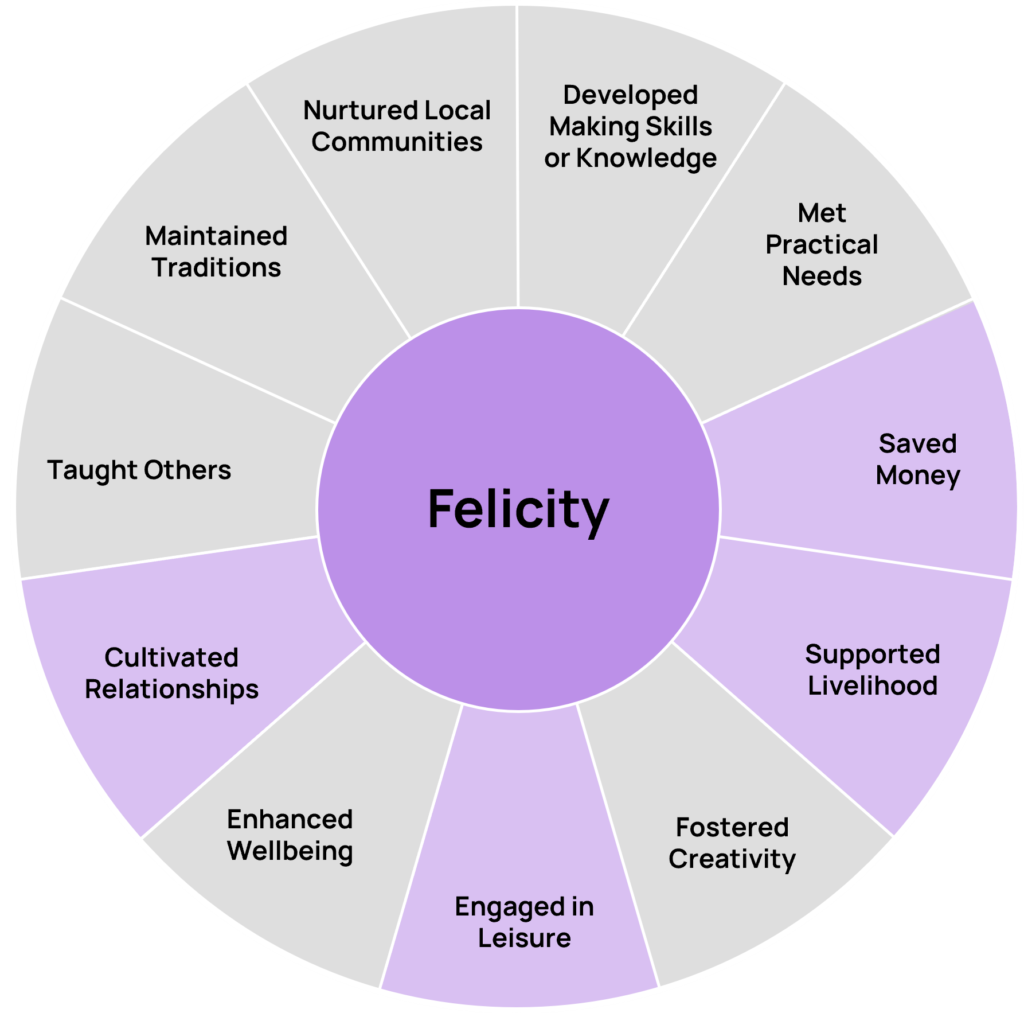
Felicity is a Latina woman in her 50s with a full-time government job and a part-time side business as a creative professional. She appreciates that her public library’s makerspace provides free, no-cost access to crafting equipment and creative software and has realized several outcomes: Saved Money, Supported Livelihood, Engaged in Leisure, and Cultivated Relationships.
For the past six years, she has been traveling to different library makerspaces in and around her locality to use Adobe Creative Suite services for her side business (Supported Livelihood). Even when traveling out of state, Felicity maps public makerspaces with free software access so she can continue working on her assignments. The opening of the makerspace at her public library offered her a convenient location to visit frequently because of its proximity to her workplace. Felicity often uses the space in the evenings after her day job, when it offers her a quiet work environment that allows her to work efficiently and concentrate on digital editing without distractions. Since a high-quality printer was added, Felicity has also been able to create prints for her clients for free, using the printing paper she donated to the makerspace (Saved Money).
Even though Felicity primarily comes to the makerspace to work on her business orders, she has used almost all the equipment it offers, including the Cricut, laser cutter, soldering irons, and 3D printer. Using the different resources in the makerspace, she enjoys keeping herself busy and trying new things when she is bored (Engaged in Leisure). In the past, she has also worked together with her daughter to use the Cricut to create onesies to announce the birth of a new baby in their family (Cultivated Relationships). The craft table in the makerspace provided them with plenty of room to work and an alternative space to be messy outside their home. Additionally, given the availability of laser-cutting machinery, which is often expensive to own, she has also influenced her husband to pursue his own creative projects in the makerspace.