Outcomes Framework for Adult Participation in Public Library Making Activities
This framework documents 11 key outcomes that adults seek and achieve through their participation in public library making activities. The outcomes are organized as a wheel to illustrate the non-linear, non-hierarchical relationship among them. Our research has shown that each of the 11 key outcomes is distinct, although some may be related or co-occur for certain individuals or situations. The maker is at the center because the specific outcomes desired and achieved reflect each person’s unique interests, priorities, experiences, and goals.
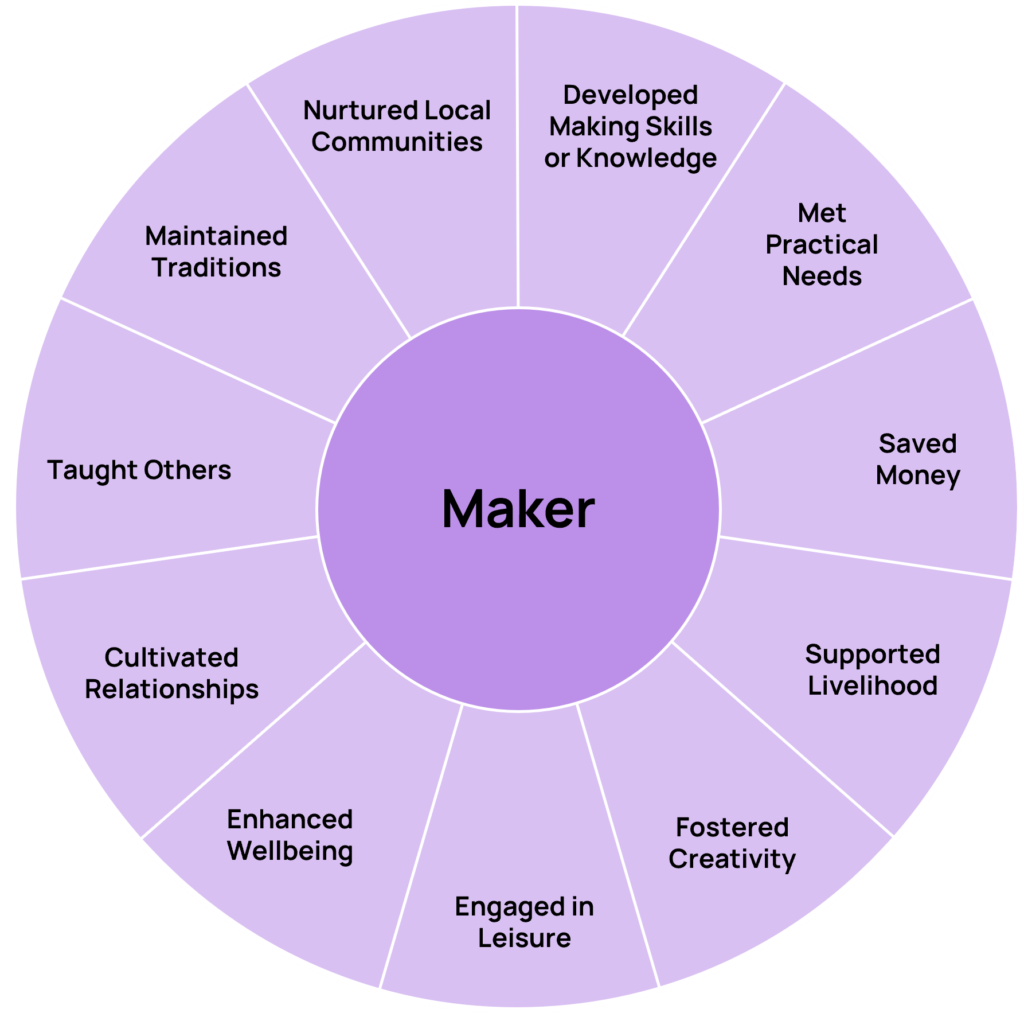
Each of the 11 key outcomes in the framework is a potential outcome of adult participation in makerspace activities. Our research indicates that the actual outcomes adults achieve depend on each person’s unique interests, priorities, activities, and goals. For example, many makers in our study developed making skills or knowledge by participating in making activities. However, others arrived with strong making skills or knowledge and did not identify learning as an outcome of their engagement.
In addition, makers vary in their desired outcomes for participation. For example, some makers in our research participated in makerspace activities specifically to learn how to use the equipment or develop particular skills. In contrast, others visited for different reasons – such as engaging in leisure or cultivating relationships – with learning as an incidental byproduct of their engagement.
Outcome Descriptions

Developed Making Skills or Knowledge
Maker deepened ability to complete makerspace projects or activities. Learned new things about makerspace equipment, design, or materials. Gained information, ideas, or feedback from other people. Developed new ways of solving problems or generating solutions.

Met Practical Need
Maker satisfied their requirement for specific objects by making items or modifying existing items to suit makers’ specific preferences, taste, or needs. Repaired, repurposed, or recycled items or materials.

Saved Money
Maker reduced expenses by creating items in the makerspace rather than purchasing them or using makerspace equipment or software rather than purchasing, subscribing, or paying to use them elsewhere. Gained access to equipment or software that would have otherwise been cost prohibitive.

Supported Livelihood
Maker started, grew, or maintained a business by leveraging skills developed in the makerspace or using makerspace tools or materials. Advanced current employment or moved toward a new job or career by creating items or developing skills in the makerspace. Generated income via makerspace activities, such as creating products, marketing materials, or product packaging.

Nurtured Creativity
Maker brought ideas to life by using the makerspace or satisfied their need to develop new ideas or items. Gained inspiration from materials, tools, projects, or people in the makerspace. Deepened their existing practices by expanding to new materials, tools, techniques, or skills.

Engaged in Leisure
Maker had fun, relaxed, or played as part of making activities. Engaged in making-related hobbies or recreational activities. Passed the time in a positive way or avoided being bored by visiting the makerspace.

Enhanced Wellbeing
Maker gained respite from demands of home, family, work, or other responsibilities by visiting the makerspace. Relieved stress, rested, or recovered from challenging experiences. Felt a sense of satisfaction, accomplishment, pride, or self-confidence related to makerspace activities or items created. Received encouragement, moral support, or camaraderie. Expressed or explored beliefs, meaning, or connections that were greater than the maker themself.

Cultivated Relationships
Maker socialized with others or met new people through making activities. Spent quality time with family or friends by working on projects together. Provided care, activities, or positive interactions for children by visiting the makerspace. Created gifts, including customizing or personalizing items for other people.

Taught Others
Maker shared information, ideas, or skills with others. Introduced other people to making activities or skills or facilitated others’ making activities.

Maintained Tradition
Maker passed making activities or skills from an older generation to a younger generation. Pursued activities or skills to continue a cultural tradition or a practice of a previous generation.

Bolstered Local Communities
Maker contributed to nonprofit organizations, faith communities, charities, or their neighborhoods by making and donating items. Raised awareness about issues or needs by making promotional items in the makerspace.